Define the mission scope before selecting a resource
A store mission, bank mission and residential scenario are different projects. Write down the interaction you need and identify which package supplies the scene, gameplay sequence and framework integration. A category name does not establish that every mission type is included.
This guide concerns fictional gameplay and virtual rewards in GTA V/FiveM. It uses qb-storerobbery as a source-reviewed example, not a ranked product comparison or a claim of hands-on gameplay testing.
What the pinned manifest establishes
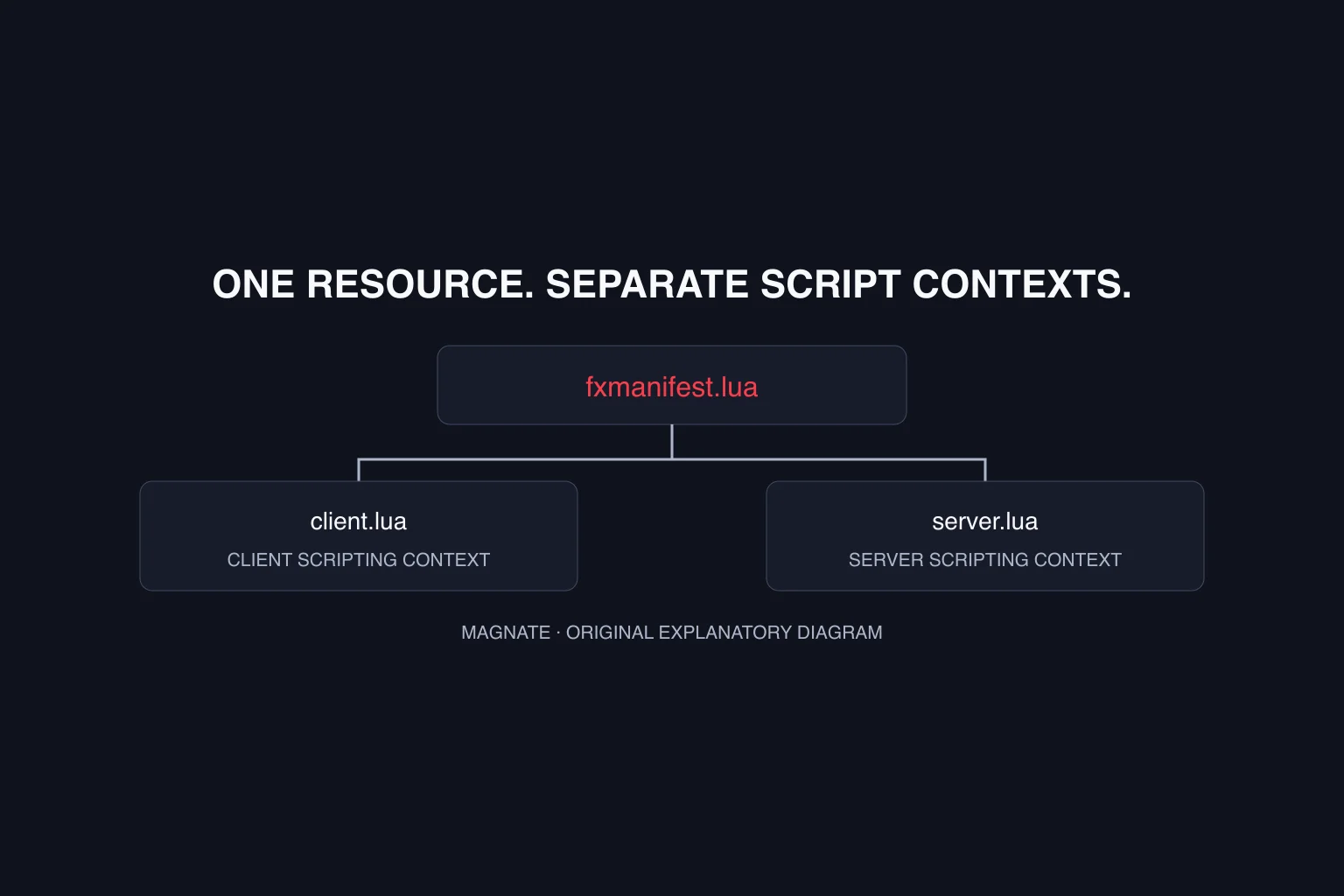
The reviewed qbcore-fivem/qb-storerobbery commit is c906b95088b2f0822ec57d16d26e7ba71f7d1c8d. Its manifest identifies version 1.5.0, client and server Lua scripts, QBCore locale data and an HTML NUI page with packaged JavaScript and CSS. Record this revision when comparing it with a fork.
Keep UI loading and gameplay completion separate. A blank panel requires different evidence from a completed interaction with missing virtual items. The manifest describes packaged code and files; it does not prove compatibility with your appearance, inventory or dispatch replacements.
Check actual inventory callers
The pinned server implementation obtains QBCore player and shared-item data and calls qb-inventory exports. Its reward paths add virtual items such as markedbills with item information. Do not expect a cash-balance change merely because a notification describes a reward.
For a replacement inventory, require a supported integration and test the normal gameplay path. Keep starting inventory, final inventory and any relevant item metadata in the same record. An animation completing cannot establish that the intended item was stored correctly.
Register and safe reset logic differ
The pinned config sets resetTime to thirty minutes and tickInterval to one second. The server register-state path assigns that configured duration. Its safe-state path instead schedules a randomized forty-to-eighty-minute timeout. Changing one timer is not evidence that the other path changed.
Record the object identity and transition time when diagnosing an unavailable interaction. An entire location should not be labelled broken simply because one of its independently tracked objects remains unavailable.
| Object | Source observation | Record during a test |
|---|---|---|
| Register | Configured resetTime assigned to its state | Register identifier and observed transition |
| Safe | Separate randomized server timeout | Safe identifier and elapsed interval |
| Whole location | Multiple separate records | Which exact interaction failed |
Keep custom interiors and interaction positions aligned
The configuration lists separate register and safe records. If you replace the scene, compare the intended interaction positions with the actual accessible surfaces. A good-looking interior does not certify that an existing mission configuration still matches it.
On staging, preserve the original configuration and change one location at a time. Approach through the normal entrance, reproduce the failure and retain the first relevant error. Report the map version, player conditions and exact affected object rather than changing several resources simultaneously.
Test the complete state and reward lifecycle
Use the proposed matrix below with controlled test characters. Define the expected behavior from your selected release before each attempt. It contains no observed gameplay results.
Exercise the supported interface instead of invoking internal reward events as a shortcut. A useful integration check must include the conditions and state transitions that players normally encounter.
| Scenario | Expected behavior to define | Evidence to retain |
|---|---|---|
| Eligible interaction | Correct prompt and start conditions | Character context and location |
| Unavailable object | Intended rejection without duplicate completion | Shared object state |
| Cancelled attempt | Documented cleanup behavior | Timing and final state |
| Completed interaction | Correct virtual item and metadata | Before/after inventory |
| Second test player | Intended shared-state behavior | Both client observations |
| Reset interval | Object becomes available under its own rule | Object identity and timing |
| Reconnect or restart | Expected state for the installed version | Before/after records and errors |
Prepare a useful maintainer report
Include the project owner, commit or release, configuration changes, framework and inventory versions, and the smallest normal-action reproduction. Distinguish a scene issue from a missing UI asset, an item API mismatch or a reset-state observation.
The inventory scripts guide covers item lifecycle boundaries; the MLO guide covers scene checks. Retain the original files so any proposed change can be compared and reversed.
Source and testing scope
Magnate rechecked the pinned manifest, config and server source on November 15, 2026. No resource was installed, database changed or FiveM session started. The acceptance matrix is original proposed planning, not a production-readiness certification.
These GTA V/FiveM findings do not establish GTA VI support. Keep the supported game and actual resource revision attached to any later runtime evidence.
Questions, answered.
Does resetTime control every cooldown?
Not in the reviewed source. The safe uses a separate randomized timeout from the register timer.
Is the reviewed reward paid directly as cash?
The cited reward paths add virtual inventory items such as markedbills. Inspect any local changes and the actual path being tested.
Has Magnate tested this resource in gameplay?
No. This is a pinned-source review and an original proposed acceptance plan.
Sources & editorial notes
Source review: November 15, 2026. Platform announcements can change. This guide separates published facts from Magnate’s original analysis and preparation advice.
- QBCore — qb-storerobbery pinned manifest Rechecked November 15, 2026. Pinned source review only; no gameplay test.
- QBCore — qb-storerobbery pinned config Rechecked November 15, 2026. Pinned source review only; no gameplay test.
- QBCore — qb-storerobbery pinned server Rechecked November 15, 2026. Pinned source review only; no gameplay test.
Published by an independent editorial brand. Read our editorial standards.